Will AI Replace Jobs in 2026? Jobs, Skills & Careers
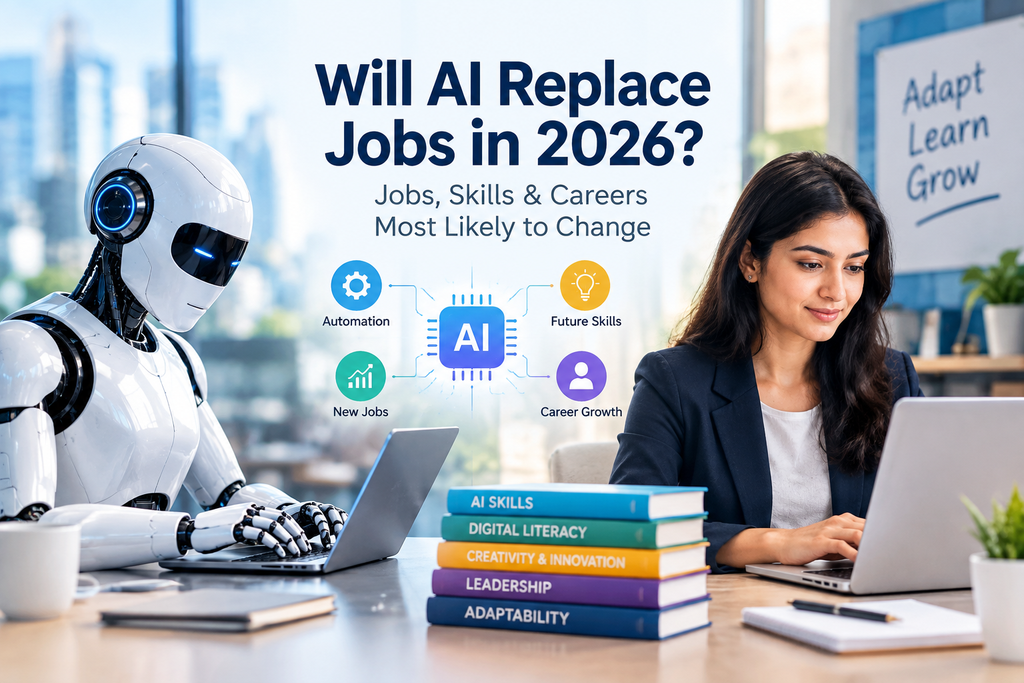
Artificial intelligence is changing the workplace faster than many people expected. Generative AI can write, summarize, analyze data, create images, assist with coding, and automate repetitive tasks. This raises an important question: Will AI replace jobs in 2026?
The evidence suggests a more complicated picture than simple job replacement. The International Labour Organization (ILO) says most occupations are likely to experience job transformation rather than complete redundancy, because many jobs contain tasks that still require human input.
At the same time, AI is changing the skills employers need. PwC’s 2026 AI Jobs Barometer, which analyzed more than one billion job advertisements across 27 countries, found that jobs requiring AI skills are growing much faster than the overall jobs market.
Will AI Replace Jobs in 2026?
AI is more likely to replace tasks than entire occupations in many cases. Jobs involving repetitive, predictable, and highly digital tasks may experience greater automation, while roles requiring judgment, creativity, leadership, communication, and complex decision-making can be reshaped rather than simply eliminated.
The OECD identifies three major ways AI affects employment: automating existing tasks, creating new tasks and occupations, and improving worker productivity. These effects can happen at the same time.
This means the key question is not only “Which jobs will AI replace?” but also “Which parts of my job can AI perform, and which parts become more valuable because of AI?”
Which Jobs Are Most Affected by AI?
AI exposure does not automatically mean a job will disappear. However, occupations with large amounts of repetitive cognitive or digital work may face greater pressure to automate.
Jobs at Higher Risk From AI Automation
Some tasks commonly affected include:
- Data entry and routine administrative work
- Basic content production
- Repetitive customer support
- Simple document processing
- Routine data analysis
- Basic translation and transcription
- Certain repetitive coding tasks
- Scheduling and standard reporting
The ILO’s research emphasizes that AI exposure and job automation are not the same thing. A job can contain highly exposed tasks while still requiring people for judgment, responsibility, communication, or other activities.
Jobs Likely to Change Rather Than Disappear
Many professional roles may increasingly use AI as a productivity tool.
For example, a marketer may use AI to generate initial campaign ideas while spending more time on strategy. A software developer may use AI coding tools for routine implementation while focusing more on architecture and quality control. A lawyer may use AI to summarize documents while concentrating on interpretation and case strategy.
This shift is sometimes described as AI augmentation: technology performs selected tasks while humans remain responsible for the broader outcome.
What Jobs Are Growing Because of AI?
AI is also creating demand for new technical and hybrid roles.
Examples include:
- AI and machine learning specialists
- AI product managers
- Data and AI engineers
- AI governance professionals
- Cybersecurity specialists
- AI implementation consultants
- Automation specialists
- AI trainers and evaluators
PwC’s 2026 research found that job postings requiring specific AI skills were growing approximately eight times faster than the overall jobs market in its analysis. It also found a substantial wage premium associated with AI skills.
However, AI careers are not limited to people who build machine-learning models. Businesses increasingly need professionals who understand both AI and a specific industry or business function.
What Skills Will Matter Most in the AI Economy?
The future of jobs is not simply about learning how to use another AI tool. Workers will increasingly need a combination of technical, analytical, and human skills.
AI Skills and Digital Literacy
Understanding generative AI, automation, data analysis, AI-assisted workflows, and responsible AI use can help workers adapt as technology changes.
Human Skills Become More Important
AI can produce outputs quickly, but organizations still need people to evaluate those outputs and make decisions.
Skills such as:
- Critical thinking
- Communication
- Creativity
- Leadership
- Collaboration
- Problem-solving
- Judgment
- Adaptability
can become increasingly important.
Why Adaptability Matters
AI tools, workflows, and required skills can change quickly. The ability to learn new tools and adjust to changing responsibilities may therefore become more valuable than mastering one specific software product.
The Key Takeaway
The strongest career strategy in an AI-driven workplace is not necessarily to compete with AI at tasks AI performs well. It is to combine AI capability with skills that create context, judgment, responsibility, creativity, and human value.
The OECD’s 2026 research similarly reports increasing importance for data analysis and interpretation skills and identifies skills shortages as a major barrier to AI adoption.
How AI Is Changing Entry-Level Jobs
One important change is happening at the beginning of people’s careers.
PwC’s 2026 analysis found that AI-exposed entry-level roles are increasingly demanding skills traditionally associated with more experienced positions, including leadership and judgment. Its analysis of U.S. data found that these AI-exposed entry-level roles were seven times more likely to require traditionally senior skills.
This could change the traditional career ladder. If AI handles some routine work that once helped junior employees learn through repetition, companies may need new ways to provide training, mentoring, and practical experience.
How to Prepare for the Future of Jobs
Workers do not need to predict exactly which jobs AI will replace. Instead, they can focus on becoming more adaptable.
Consider these steps:
- Learn AI tools relevant to your profession.
- Automate repetitive tasks where appropriate.
- Develop strong analytical and communication skills.
- Build deeper industry knowledge.
- Learn to evaluate AI-generated information.
- Create evidence of your ability to use AI productively.
- Keep updating your skills as tools and workflows change.
The ILO’s 2026 research highlights AI literacy, adaptability, resilience, and human agency as important elements of the changing workplace.
The Future of Jobs Is About Transformation
So, will AI replace jobs in 2026? Some tasks and certain roles will undoubtedly face automation pressure, but current research does not support the idea that AI will simply eliminate work across the economy.
Instead, the evidence points toward a labor market where jobs are redesigned, new AI-related roles emerge, and employers place greater emphasis on both AI literacy and human capabilities. The OECD notes that AI can complement human labor while also creating displacement risks, particularly in routine and repetitive work.
For workers, the practical lesson is straightforward: learn to work with AI rather than treating AI only as a competitor.
The careers most resilient to technological change may be those where people can combine domain expertise, AI literacy, critical thinking, creativity, communication, and sound judgment. The future of work is therefore likely to be less about humans versus AI and more about how effectively humans and AI work together.